
The Evolution Of Revolution
the evolution of one mans dreams and goals...
The history of Revolution 98 will take you back in time to see the evolution of one mans dreams and goals. Stephen Jon Shidler is responsible for bringing this project together, and you will see from his credentials, that this is no overnight dream. His years of experience in sailing started at a very young age, and his movements through the waters of the world brought him to the forefront of technology in the marine industry.
The conception of this revolution started back in Hawaii in 1949. Shidler's mother was 8 months pregnant with Stephen when she sailed to San Francisco, it's possible that this was the reason for his immediate love for boats and the water. Throughout his upbringing, his interests in seamanship grew with him. Actively involving himself in the sport led to a sailing scholarship at the University of Hawaii. During these college years, Shidler completed two sailing voyages to the South Pacific. After earning a degree in Real Estate, the next move was to create a business with a proper economic, and time off equation, to devote full time to marine activities. He
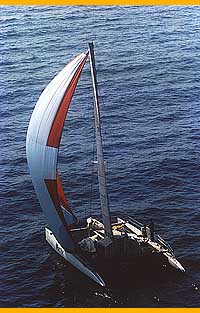
found his niche in Real Estate Renovations in San Francisco, and moved through a progression of several ocean sailboats, leading to the purchase of what would be his most radical sailboat, "Wind Warrior".
With a goal of owning the fastest ocean sailboat on the West Coast, Shidler acquired a used Morrelli 45 foot. The boat belonged to what would be a revolutionary family in sailing technology, out of the same mold came its little brother, the Smyth team Formula 40 World Champion. From the same builders and designers evolved the Americas Cup Catamaran, still to date the fastest Americas Cup sailboat produced.
REVOLUTION IN SAIL
To bring Wind Warrior
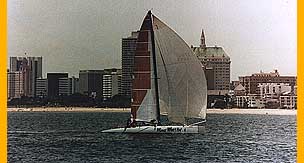
to its peak performance, three years of time and energy was spent. three different masts, three different cabins, testing in Trans ocean races, and countless miles of
cruising proved to be instrumental in the procedure of fine tuning the boat. New rudders, daggerboards, and sails were part of the ingredients to be always faster, always stronger. Carbon Fiber Wing masts, asymmetrical multihull spinnakers, mainsail camber inducers, wire hydraulic mainsheets, and rotational mast electronics were all part of the equation as well.
Shidler felt his mission to create the fastest sailboat on the coast was accomplished in 1986 and 87.
THE MOVE TO POWER
Shidler’s next step certainly wasn't a logical step in the sailing world, but one that would allow him to accomplish his new personal ambitions.
1/ The first Trans Pacific crossing above displacement speed by a power boat. 2/ To explore areas never seen by world cruising yachts.
3/ To create a vessel that could be legally trailerable, and fit inside a 40 ft container for shipping. 4/ To set a precedence in revolutionary, small family cruise boats.
5/ To set a record for the world's longest outboard passage.
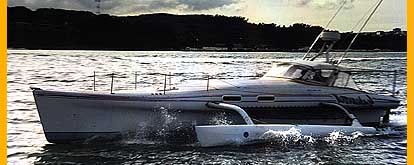
To bring the project to reality, the Americas Cup 88 design and building team was recruited to build the boat. Under Shidler's philosophy of "Maximize Movement and Minimize Energy" the team set out to build a powerboat that would break traditions in efficiency. The design of choice was a 40 ft trimaran constructed of DuraKore Balsa strip plank, with carbon fiber and epoxy resins. The ultra lightweight craft was powered by twin outboard 27 hp Yanmar diesels. Launched under the name "ENDEAVOUR" preparations to begin the journey started immediately. Testing the craft entailed changing rudders and fins 5 times, working through a selection of 22 propellers, and 4 engines.
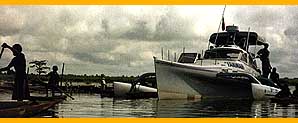
Once perfected, the Trans Pacific journey began. With a crew of only 2, Shidler set out from San Francisco, crossed to Hawaii, and continued to Sydney Australia. This voyage set records in fuel efficiency and distance traveled by outboard power. The next three months were spent cruising the rivers and inlets of Papua New
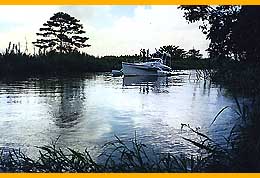
Guinea, in places where no other cruising boats had ventured.
Shidler’s next venture would be the building of "Revolution" the 60 ft power trimaran this web-site is dedicated to.