Revolution
Around-The-World Record Is Target Of Advanced Powerboat
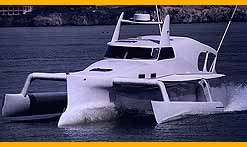
Stephen Shidler is quick to tell people his philosophy, "Maximize movement, minimize energy," and why he has adopted it. In February 1998, this efficiency guru will attempt to break the around-the-world speed record. What sets this effort apart from others is that his vessel of choice is a powerboat that combines the best technologies from sailboats and high-speed ferries to obtain a speed-to-fuel-efficiency ratio that defies conventional logic.
Aboard his custom-built, power trimaran, Revolution, Shidler hopes to complete the 26,000 mile journey in 70 days. This will beat the existing powered craft record of 83 days, 10 hours set by the USS Triton nuclear submarine and the existing sailboat record.
He will leave from Miami Beach, pass through the Panama Canal to Mexico and then travel to Hawaii. From there, he plans to proceed along the most direct route around the globe, which may include stops in Kiribati, Papua New Guinea, Singapore, India, Saudi Arabia, the Suez Canal, the Mediterranean and the Azores, before returning to Miami.
"Setting the around-the-world record above displacement speed in a powerboat is an efficiency and endurance challenge," said Shidler. "Although my boat is swift, it was not built to simply go fast. I wanted her to move as quickly as possible with the least amount of energy applied. I have achieved this so well with the trimaran design and light weight, that she can move with up to 10 times greater efficiency than other ocean-going vessels of similar size and speed.
Revolution is truly a unique craft. Ten of the best sailboat, high-speed ferry and industrial design firms from five countries collaborated to create this highly efficient 60' trimaran. These designers have produced boats that hold records in the America's Cup, B.O.C., Jules Verne and other speed sailing races and hold contracts with military, naval and space agencies as well as automobile manufacturers. Kavearna Masa, Europe's largest ship builder and a major supporter of this effort, helped with the design of the craft and consulted during different stages of the construction process to ensure the most efficient hull design.
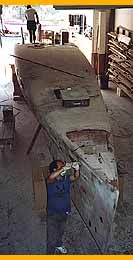
Built to be as light as possible, the boat's semi-displacement main hull and two outer hulls are constructed from balsa core strip planks uni- directional fiberglass with carbon fiber throughout. They were bonded and baked with epoxy. Kevlar was added for safety and durability. Hydrofoils on the outer hulls ensure stability.
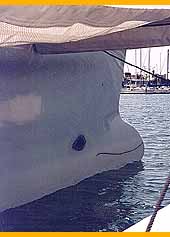
Painted to resemble a shark on one side and dolphin on the other, the main hull is only 3-1/2' wide at the waterline. Each of the outer hulls is attached by two cylindrical arms equipped with hydraulic rams, enabling a full 18' of movement up and down. Using these, along with the six fuel tanks, Shidler can adjust trim and reduce roll and pitch to increase efficiency, which is his undying goal.
"We want to inspire people to constantly move toward greater results with fewer resources, not only in the boating world, but in every area of life," said Shidler.
The boat is currently equipped with a 225 hp inboard diesel test engine. It can sustain a speed of 21 knots for more than 2,500 miles without refueling. Shidler estimates that this voyage require less than 5% of the fuel and 1% of the horsepower and cost as the current Trans-Atlantic speed record while producing less than 5% of the total exhaust emissions and taking him 9 times farther.
Presently at Pier 39 in San Francisco, the boat is completing the planned 10,000 miles of ocean testing. To facilitate easier navigation, Shidler has equipped Revolution with Cetrek autopilot and chart-plotting equipment. Racor was chosen to provide filtration for all diesel fuel and oil. Teleflex supplied the steering equipment. He is still accepting bids for a title sponsor, although one is not needed to complete the journey.
This around-the-world effort has been a 25 year goal for Shidler. Over the last ten years, he has undertake many similar adventures to prepare for it. In 1987, he was first to finish the Trans Pacific race from Los Angeles to Hawaii aboard Wind Warrior, his 48' Morrelli and Melvin designed catamaran sailboat. In 1989, he motored from San Francisco to Sydney aboard Endeavour, the 40' custom-built trimaran that was the prototype to Revolution. Powered by two, 27 hp diesel outboards, the boat covered 7,200 miles to set record for speed, fuel efficiency and distance traveled by a powerboat. All the sponsors of this previous trip are participating in his current around-the-world challenge.