


Cheater Hater
Cheater Hater's plan is quoted in the first spoiler.
My comments.
I’m doing these in the order they were posted. I think I’m going to digress quite a bit extra on this first one, since I want to explain some of my general thoughts about the situation. Also, as this will be the first time I mention a lot of things, it will probably go into extra depth on just about everything. It's probably a good idea, if you only read comments on your plan and one other, to read this one.
Cheater Hater's plan is quoted in the first spoiler.
(November 22nd, 2013, 00:38)Cheater Hater Wrote: Great idea, and something quick to actually try
I was bored, and thus I'll get the ball rolling:
These notes are very rough, I just took them as I played the save--I think the only thing I didn't note was which tiles Beijing grew onto--it's working corn/cottage/banana at size 3, but I'm not sure which it grew onto first. I might tidy up the notes later, and I'll answer questions if anything's unclear.
(note: complete=can do next action)
Best spot seems to be SE (plains hill, food, floodplains, river, but it wastes a turn on quick--try that first
T1: Settle Beijing (work corn), worker first, research BW
T9: Worker 1 completes, farms corn, build Worker 2
T10: BW completes, research Wheel
T12: Farm completes, Worker moves NW and chops
T15: Wheel completes, research Pottery
T16: Worker 2 completes, moves NE-N and chops, build Settler
T17: Worker 1 completes chop, moves SE onto farm and roads 1 turn
T18: Worker 1 moves E, farms Banana for 2 turns
T20: Settler 1 completes, build Settler 2 (with chop overflow) for 1 turn, Settler 1 moves S-S, S-SW, Worker 2 chop completes, moves SW and chops
T21: Pottery completes, research AH, Beijing switches to Granary, Worker 1 moves SW and cottages
T22: Settle Shanghai (work floodplain), build Granary
T23: Beijing switches to Settler (to receive chop)
T24: Worker 2 chop completes, cottages in place
T25: Settler 2 completes, moves N-N, NW-N, Worker 1 moves S, cottages for 1 turn
T26: Worker 1 moves S-SE, mines copper
T27: Settle Guangzhou (work oasis), build Granary, Worker 2 moves NE, cottages for 1 turn
T28: AH completes, research Fishing, move slider to 60%, Worker 2 moves N, pastures sheep
T30: Worker 1 mine completes, roads
Overview:
I like wasting the turn to move onto the good plains hill spot for Beijing, but I'm not sure where Shanghai and especially Guangzhou should go. I like the worker moves in general--maybe I should complete the banana farm, but that delays the floodplains cottage and the copper more than I like.
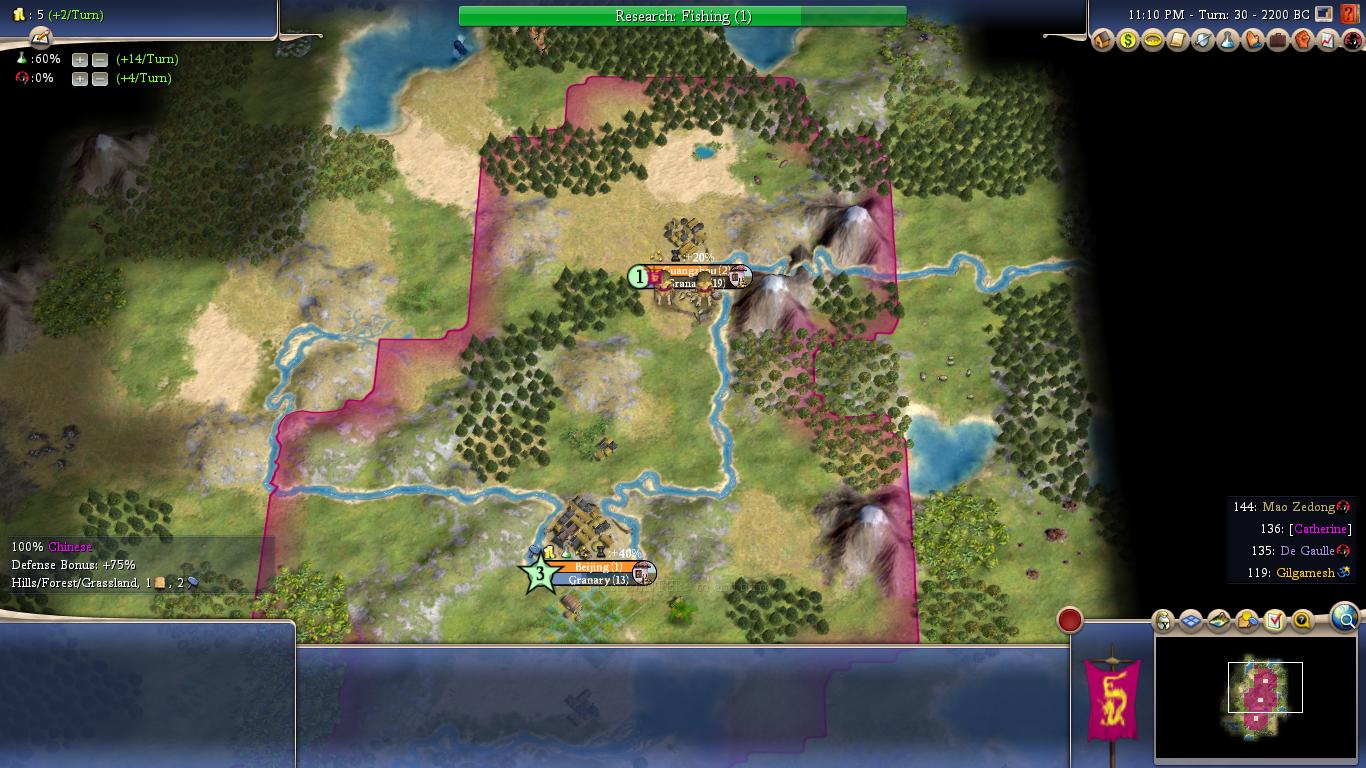
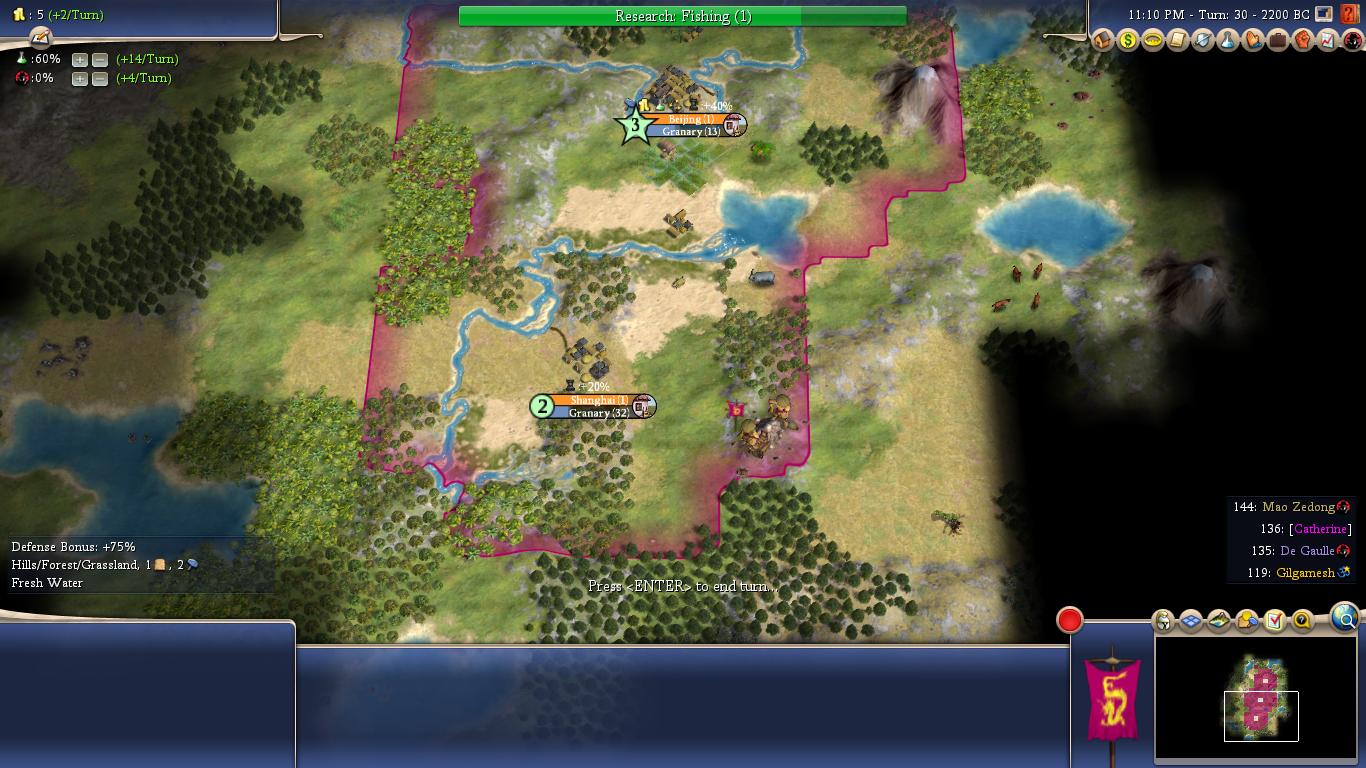
My comments.
I’m doing these in the order they were posted. I think I’m going to digress quite a bit extra on this first one, since I want to explain some of my general thoughts about the situation. Also, as this will be the first time I mention a lot of things, it will probably go into extra depth on just about everything.
It's probably a good idea, if you only read comments on your plan and one other, to read this one.Strategic thoughts
Moving to the plains hill was a good call. There are many options for which tile to settle on, and the plains hill is the best long-term site and second-best short-term site. In my opinion, the only better option was to settle on the banana, and that’s the kind of move that has the potential to be a mistake: it kind of wastes the banana resource; the extra food isn’t strictly better than an extra hammer because we’re IMP; it decreases the number of riverside tiles in our capital; and it moves away from what looks at a glance to be the best expansion site - the oasis/pigs/sheep plainshill spot. In a real game, I would definitely want to try out both locations (that plains hill, and the banana) and compare them. I don’t fault anyone for settling on the plains hill though.
Worker first to improve the corn is clearly good.
About the tech choice: Aside from the necessary first-row techs, the three key ancient techs are bronze working, animal husbandry, and pottery. BW reveals copper, enables whips, and enables chops. Pottery enables granaries and cottages. AH reveals horses and unlocks quite a few standard food tiles. Opening tech strategy is to a great extent a question of what order to get these three techs in. This scenario ended up being a great example of that. You chose to go for BW first, then (wheel and) pottery, and then lastly AH. BW was for chops, and later, copper. I think this is a dubious choice on quick speed. Chops are only worth 3.25h per worker turn spent on them, and generally speaking, improving tiles will give better returns. The forests can then be saved for later, when you have less low-hanging fruit in terms of resources that need to be hooked; when you are trying to build a granary ASAP; and/or when you have Math so that you can get better yields from them. It’s true though that IMP boosts the utility of chopping forests compared to slowbuilding settlers working food tiles. Arguably your settling plan doesn’t need AH nor pottery so early, so you might as well get BW. However, I think with pottery you could develop the capital better, or with AH you could settle a better second city.
I don’t like the choice of city locations very much. It’s good that you claim copper in one of your first three cities, but the placement of Shanghai is not ideal IMO. I would rather place it on the plains hill 3 to its east - the extra hammer from the city tile is worth a lot. More importantly, it’s pretty weak in terms of immediate resource claiming. I would rather claim a food resource with the second city, or at least share a good food tile with the capital and claim a strategic or luxury resource. Strategic resources are in pretty bad spots on this map so I’d rather claim one with the third city.
I do like very much that your 2nd and 3rd cities claimed both a very strong spot in terms of resources, and copper.
Micro thoughts
Generally speaking: Micro involves a lot of tradeoffs. Only rarely are there opportunities to improve something without sacrificing something else. However, there are a lot of times where you can see that something isn't living up to its full potential. These are the areas where it's good to look, and see if there's a good trade you can make - a little less food for a few more worker turns, or something like that. Make enough good trades and you can come out far ahead.
I noticed that worker 1 has an idle turn according to your notes. He spends 4t farming, 4t chopping, 1t roading, 2t farming… and then sits around a turn before pottery is in and he puts in the cottage turn. I'm assuming you did something with him and just forgot to write it down.
Your first two chops come in at the tail end of their respective builds, IIRC not accelerating either one and instead providing overflow into the next build. While this isn’t inefficient in and of itself, it does indicate an area for improvement: 1) if one of the chops could be completed sooner, the build would also complete sooner. 2) The chopping worker could perhaps complete another task first and chop afterwards, seeing as the chop is coming in several turns before it’s actually put to use. Then the other task’s completion could perhaps provide some benefits in the meantime.
Your Shanghai settler reaches its flatland city tile exactly. This means that with a single tile of road movement it could settle a turn sooner. It’s unfortunate that the river south of the capital makes it impossible to achieve this with just one road. It might be worth building two roads, though.
Worker 1 starts a couple of things that he doesn’t finish. While this is a big step up from wasting whole turns in transit without performing actions, it does also indicate an area for improvement in the plan. Some resources are not being put to use. Is there a way to make them useful?
Shanghai is founded without a trade connection to Beijing. This omission costs 2c per turn. In addition, trade routes are only recalculated at end of turn or when founding a city, so when you finally do complete that connection, you will have to wait a turn to get it unless you found a city that same turn. The more of these things I notice, the more I think that worker 1 should have built a pair of roads towards Shanghai.
Shanghai starts on a granary and I think this is a suboptimal for a few reasons. 1) It’s not going to finish that granary for quite a while. 2) You need a few warriors and have built none so far. 3) That city has fairly low food (it has a couple FP but no real food resources, and it has two great resources that cost food), so it won’t benefit much from a granary at all. I would rather grow that city up enough that it can work its good tiles and then produce workers/settlers at ~0 food surplus for a while, before investing in a granary. Your instincts are good: granaries are incredibly strong buildings. But I think this isn’t the time or place.
On t21 you only have two important techs left to get: hunting and AH. And you already have a settler by the hunting resource, but you research AH first. Since hunting gives a discount on AH, it would be nicer to research them in the other order. That doesn’t mean that this order of research was the wrong choice, but again it indicates an area that might be improved. You sacrificed some city value by delaying AH this long (which I think is a very viable move with this position), but didn’t get full value out of that sacrifice because you couldn’t fit in hunting before AH.
On t23, Beijing switches back to the settler 1t away from growth. Again, this timing is not ideal. The timing of the chops isn’t working harmoniously with the rest of the plan. So this is a place to look for potential improvements.
I don’t like cottaging the silks. You will want to plantation the silk later on for sure, so all the turns of work you put into that cottage to grow it to a town will have to be thrown out. It would be better to farm that tile, and better still to improve other tiles first.
Guangzhou would be better placed on the plains hill. If you did want to put it on the flatland though, it would be worth spending two worker turns to road the silk, so that you can settle 1t sooner.
Looking at the ending overview, you didn’t complete a single road, and that is a good area to focus on improving. Roads are surprisingly important: if built soon enough, they accelerate settlers to their destinations. They connect cities so you can get commerce from trade routes. They allow workers more freedom in travelling to where they are needed. And - easy to forget - they make it much easier to defend. It’s something of a moot point here because you didn’t have more than the starting warrior done anyway, but it’s really valuable to be able to move your military around from one city to another to respond to threats - it lets you get away with fewer units.
You did get two workers right from the start, but they spent so much time chopping that you still don’t have enough improvements. (As I mentioned earlier, chopping on quick speed isn’t that great.) You spent 12 worker turns chopping, and your second worker has only existed for a bit longer than 12 turns! Meanwhile 3 chops (12 chop turns) about pays for one worker. So from a a number-of-improvements perspective, it’s kind of like you’ve only had 1 worker the whole time, while going from 1 to 3 cities. It’s no big surprise that these cities are under-improved. As a rule of thumb, the more you chop, the more you need more workers, and you only built about enough workers to build appropriate improvements for this many cities if they don’t chop at all.
Moving to the plains hill was a good call. There are many options for which tile to settle on, and the plains hill is the best long-term site and second-best short-term site. In my opinion, the only better option was to settle on the banana, and that’s the kind of move that has the potential to be a mistake: it kind of wastes the banana resource; the extra food isn’t strictly better than an extra hammer because we’re IMP; it decreases the number of riverside tiles in our capital; and it moves away from what looks at a glance to be the best expansion site - the oasis/pigs/sheep plainshill spot. In a real game, I would definitely want to try out both locations (that plains hill, and the banana) and compare them. I don’t fault anyone for settling on the plains hill though.
Worker first to improve the corn is clearly good.
About the tech choice: Aside from the necessary first-row techs, the three key ancient techs are bronze working, animal husbandry, and pottery. BW reveals copper, enables whips, and enables chops. Pottery enables granaries and cottages. AH reveals horses and unlocks quite a few standard food tiles. Opening tech strategy is to a great extent a question of what order to get these three techs in. This scenario ended up being a great example of that. You chose to go for BW first, then (wheel and) pottery, and then lastly AH. BW was for chops, and later, copper. I think this is a dubious choice on quick speed. Chops are only worth 3.25h per worker turn spent on them, and generally speaking, improving tiles will give better returns. The forests can then be saved for later, when you have less low-hanging fruit in terms of resources that need to be hooked; when you are trying to build a granary ASAP; and/or when you have Math so that you can get better yields from them. It’s true though that IMP boosts the utility of chopping forests compared to slowbuilding settlers working food tiles. Arguably your settling plan doesn’t need AH nor pottery so early, so you might as well get BW. However, I think with pottery you could develop the capital better, or with AH you could settle a better second city.
I don’t like the choice of city locations very much. It’s good that you claim copper in one of your first three cities, but the placement of Shanghai is not ideal IMO. I would rather place it on the plains hill 3 to its east - the extra hammer from the city tile is worth a lot. More importantly, it’s pretty weak in terms of immediate resource claiming. I would rather claim a food resource with the second city, or at least share a good food tile with the capital and claim a strategic or luxury resource. Strategic resources are in pretty bad spots on this map so I’d rather claim one with the third city.
I do like very much that your 2nd and 3rd cities claimed both a very strong spot in terms of resources, and copper.
Micro thoughts
Generally speaking: Micro involves a lot of tradeoffs. Only rarely are there opportunities to improve something without sacrificing something else. However, there are a lot of times where you can see that something isn't living up to its full potential. These are the areas where it's good to look, and see if there's a good trade you can make - a little less food for a few more worker turns, or something like that. Make enough good trades and you can come out far ahead.
I noticed that worker 1 has an idle turn according to your notes. He spends 4t farming, 4t chopping, 1t roading, 2t farming… and then sits around a turn before pottery is in and he puts in the cottage turn. I'm assuming you did something with him and just forgot to write it down.
Your first two chops come in at the tail end of their respective builds, IIRC not accelerating either one and instead providing overflow into the next build. While this isn’t inefficient in and of itself, it does indicate an area for improvement: 1) if one of the chops could be completed sooner, the build would also complete sooner. 2) The chopping worker could perhaps complete another task first and chop afterwards, seeing as the chop is coming in several turns before it’s actually put to use. Then the other task’s completion could perhaps provide some benefits in the meantime.
Your Shanghai settler reaches its flatland city tile exactly. This means that with a single tile of road movement it could settle a turn sooner. It’s unfortunate that the river south of the capital makes it impossible to achieve this with just one road. It might be worth building two roads, though.
Worker 1 starts a couple of things that he doesn’t finish. While this is a big step up from wasting whole turns in transit without performing actions, it does also indicate an area for improvement in the plan. Some resources are not being put to use. Is there a way to make them useful?
Shanghai is founded without a trade connection to Beijing. This omission costs 2c per turn. In addition, trade routes are only recalculated at end of turn or when founding a city, so when you finally do complete that connection, you will have to wait a turn to get it unless you found a city that same turn. The more of these things I notice, the more I think that worker 1 should have built a pair of roads towards Shanghai.
Shanghai starts on a granary and I think this is a suboptimal for a few reasons. 1) It’s not going to finish that granary for quite a while. 2) You need a few warriors and have built none so far. 3) That city has fairly low food (it has a couple FP but no real food resources, and it has two great resources that cost food), so it won’t benefit much from a granary at all. I would rather grow that city up enough that it can work its good tiles and then produce workers/settlers at ~0 food surplus for a while, before investing in a granary. Your instincts are good: granaries are incredibly strong buildings. But I think this isn’t the time or place.
On t21 you only have two important techs left to get: hunting and AH. And you already have a settler by the hunting resource, but you research AH first. Since hunting gives a discount on AH, it would be nicer to research them in the other order. That doesn’t mean that this order of research was the wrong choice, but again it indicates an area that might be improved. You sacrificed some city value by delaying AH this long (which I think is a very viable move with this position), but didn’t get full value out of that sacrifice because you couldn’t fit in hunting before AH.
On t23, Beijing switches back to the settler 1t away from growth. Again, this timing is not ideal. The timing of the chops isn’t working harmoniously with the rest of the plan. So this is a place to look for potential improvements.
I don’t like cottaging the silks. You will want to plantation the silk later on for sure, so all the turns of work you put into that cottage to grow it to a town will have to be thrown out. It would be better to farm that tile, and better still to improve other tiles first.
Guangzhou would be better placed on the plains hill. If you did want to put it on the flatland though, it would be worth spending two worker turns to road the silk, so that you can settle 1t sooner.
Looking at the ending overview, you didn’t complete a single road, and that is a good area to focus on improving. Roads are surprisingly important: if built soon enough, they accelerate settlers to their destinations. They connect cities so you can get commerce from trade routes. They allow workers more freedom in travelling to where they are needed. And - easy to forget - they make it much easier to defend. It’s something of a moot point here because you didn’t have more than the starting warrior done anyway, but it’s really valuable to be able to move your military around from one city to another to respond to threats - it lets you get away with fewer units.
You did get two workers right from the start, but they spent so much time chopping that you still don’t have enough improvements. (As I mentioned earlier, chopping on quick speed isn’t that great.) You spent 12 worker turns chopping, and your second worker has only existed for a bit longer than 12 turns! Meanwhile 3 chops (12 chop turns) about pays for one worker. So from a a number-of-improvements perspective, it’s kind of like you’ve only had 1 worker the whole time, while going from 1 to 3 cities. It’s no big surprise that these cities are under-improved. As a rule of thumb, the more you chop, the more you need more workers, and you only built about enough workers to build appropriate improvements for this many cities if they don’t chop at all.


![[Image: t15.JPG]](https://dl.dropboxusercontent.com/u/15215428/potluck/plana/t15.JPG)
![[Image: t20.JPG]](https://dl.dropboxusercontent.com/u/15215428/potluck/plana/t20.JPG)
![[Image: t25.JPG]](https://dl.dropboxusercontent.com/u/15215428/potluck/plana/t25.JPG)
![[Image: t30.JPG]](https://dl.dropboxusercontent.com/u/15215428/potluck/plana/t30.JPG)
![[Image: eventlog.JPG]](https://dl.dropboxusercontent.com/u/15215428/potluck/plana/eventlog.JPG)
 Meanwhile, delaying BW until after the second city effectively subtracts one turn from it later when you revolt. So maybe the roading thing isn’t worth it, or maybe that second city is too far away after all.
![[Image: x1ae.jpg]](http://img19.imageshack.us/img19/6659/x1ae.jpg)
![[Image: 55qp.jpg]](http://img9.imageshack.us/img9/5223/55qp.jpg)
![[Image: pxly.JPG]](http://img35.imageshack.us/img35/358/pxly.JPG)
![[Image: uhim.jpg]](http://img571.imageshack.us/img571/3193/uhim.jpg)


![[Image: gy4n.jpg]](http://imageshack.us/photo/my-images/811/gy4n.jpg/)
![[Image: dmju.jpg]](http://imageshack.us/photo/my-images/577/dmju.jpg/)
![[Image: kj7v.jpg]](http://imageshack.us/photo/my-images/21/kj7v.jpg/)
![[Image: rqq0.jpg]](http://imageshack.us/photo/my-images/13/rqq0.jpg/)
![[Image: x4c.JPG]](http://imageshack.us/photo/my-images/36/x4c.JPG/)
![[Image: dgcz.jpg]](http://imageshack.us/photo/my-images/845/dgcz.jpg/)
![[Image: esda.jpg]](http://imageshack.us/photo/my-images/855/esda.jpg/)
![[Image: nhte.jpg]](http://imageshack.us/photo/my-images/62/nhte.jpg/)
![[Image: u04h.jpg]](http://imageshack.us/photo/my-images/201/u04h.jpg/)
